
- By Hou Chengxing
- Fact-checked by Rob Ng
- Published
- Last checked
Before you ride
TL;DR
Can I take a full-size bike on a Chinese high-speed train (G, D or C train)?
On almost all routes, no—even in a soft bike bag with both wheels off. China Railway's high-speed luggage limit is 130 cm total (length + width + height) and 20 kg per item. A packed 700c road bike measures roughly 200–225 cm combined and is routinely turned back at station security.
What about the 12306 'Bike-on-Board' (自行车随身行) service?
It is real, costs ¥88 per bike, and lets you bring a bike with the front wheel removed inside a dedicated bag—but as of 2026 it operates only on two pilot corridors: the Beijing North–Chongli line (Jingzhang HSR) and the Hainan Round-Island HSR. It does not exist on trains to Guilin, Yangshuo, Dali, Lijiang or Chengdu.
How do local cyclists move bikes between cities in China?
They either fly with a hard bike box as checked luggage or ship the boxed bike door-to-door between hotels using SF Express (顺丰速运) land freight, which typically costs ¥120–260 ($17–36) per leg and takes 2 to 4 days.
Can I bring or ship an e-bike battery on a train or plane?
No. High-capacity lithium e-bike batteries are strictly prohibited on Chinese high-speed trains, conventional trains and passenger aircraft, and cannot be sent by air courier.
Why the “just take the wheels off” advice fails in China
In Europe or Japan, removing both wheels and slipping a frame into a thin rinko bag is standard practice for high-speed rail. Many English travel blogs assume the same trick works on China Railway’s G, D and C trains.
In practice, it fails at the station gate before you ever reach the platform. Every Chinese railway station runs airport-style X-ray screening and ticket checks at the building entrance. Staff there enforce a single number from the China Railway Passenger Transport Regulations:
| Train category | Max length + width + height | Max weight per piece | What passes in practice |
|---|---|---|---|
| High-speed rail (G, D, C trains) | 130 cm total | 20 kg | Small 14–16 inch folding bikes in a bag; standard luggage |
| Conventional rail (K, T, Z trains) | 160 cm total | 20 kg | Compact 16–20 inch folding bikes in a bag |
| Full-size road, gravel or MTB (wheels off, bagged) | Typically 200–225 cm total | 10–18 kg | Exceeds the limit; turned away at most HSR stations |
Do the arithmetic on a size 54 road frame: even with both wheels removed and the handlebars turned, a soft bike bag is roughly 110 cm long, 75 cm high and 28 cm wide. That adds up to 213 cm—more than 80 cm over the high-speed rail ceiling. Whether an individual security supervisor waves you through on a quiet Tuesday afternoon is not a plan you can build a multi-city itinerary around. If they say no, your train leaves without you and your bike stays on the concourse.

Where the 12306 “Bike-on-Board” service actually works
You may have read that China Railway launched an official Bike-on-Board service (自行车随身行) inside the Railway 12306 app. That service is real and well run, but its geography is narrow:
- Beijing North to Chongli (Jingzhang High-Speed Railway) — built for mountain resorts north-west of Beijing.
- Hainan Round-Island High-Speed Railway — covering 13 designated stations including Haikou, Haikou East, Wenchang, Qionghai, Wanning, Lingshui and Sanya.
On those two lines, trains marked with the “车” (bike) icon in the 12306 app let you book a bicycle slot for a base price of ¥88 per bike (refundable up to 1 hour before departure). You remove the front wheel yourself at the station’s dedicated channel, pack the bike and helmet into a reusable station bag or your own bike bag, and staff secure it in a designated storage bay onboard.
Everywhere else in mainland China—including Beijing to Guilin, Guilin to Yangshuo, Kunming to Dali, Dali to Lijiang, and Chengdu to surrounding hubs—this service does not exist. On those routes, the 130 cm rule governs the passenger cabin.
Three ways that actually work for moving a bike across China
If you are bringing your own bike to China and combining two or more regions, use one of these three methods instead of gambling at a high-speed rail security gate.
1. Ship the boxed bike hotel-to-hotel with SF Express (顺丰速运)
This is how Chinese domestic riders travel to events in Yunnan, Guangxi and Sichuan. SF Express is China’s most reliable nationwide courier, and its couriers pick up directly from hotel lobbies and bike shops.
- How it must be packed: In a rigid cardboard bike box, a hard bike case, or a heavily padded travel case. SF Express will not accept a bare bike or a thin unpadded dust cover.
- How pricing works: Bicycles are billed by volumetric weight (Length × Width × Height in cm ÷ 6000 for standard land freight, or ÷ 12000 on certain heavy-cargo tiers), compared against actual weight, whichever is greater.
- Typical cost: ¥120 to ¥260 ($17–36) per bike between major regions via land freight, plus optional declared-value insurance (保价, typically 0.5%–0.8% of declared value).
- Transit time: 2 to 4 days by land between provinces (for example, Beijing to Guilin, or Guilin to Dali).
- What to take out of the box: CO2 cartridges, chain lube, degreaser, tyre sealant bottles if shipping by air, and any loose lithium batteries with high watt-hour ratings. Carry small removable electronic shifting batteries (SRAM AXS) in your personal bag when travelling yourself.
2. Fly between regions with a bike box as checked baggage
If you are connecting far-flung hubs—such as Beijing to Lijiang or Chengdu to Guilin—flying is often easier than taking a 10-hour train while waiting 3 days for a courier box.
- Full-service Chinese carriers (Air China, China Southern, China Eastern, Sichuan Airlines, Hainan Airlines) accept hard bike cases and cardboard bike boxes as checked sporting equipment, subject to each airline’s piece, weight (usually 23 kg in economy, 32 kg in business) and linear dimension limits (confirm with the airline at least 48 hours before departure).
- Absolute prohibitions in checked bike boxes: CO2 cartridges (even a single 16 g cylinder will trigger an X-ray hold in Chinese airports, and security will require you to return to the check-in inspection room to open the box), aerosol lubricants, and lithium batteries above civil aviation thresholds. Bring a mini hand pump instead of CO2.
3. Railway consignment freight (铁路托运) on conventional trains
Major stations still operate a Railway Consignment Office (行李托运处 / 中铁快运 China Railway Express) separate from passenger check-in. Your bike travels in a baggage van on a conventional train rather than on your high-speed passenger train, and you collect it at the destination freight office a day or two later. For a foreign visitor, SF Express hotel-to-hotel pickup is almost always simpler because you do not need to navigate a cargo depot at each end.
Bringing your own bike vs renting locally in China
Before paying $150–$300 each way in international airline bike-box fees and wrestling a 130 cm box into airport taxis, weigh the logistics against what you actually plan to ride:
| Trip style | Bring your own bike | Rent from CycleQuest China hubs |
|---|---|---|
| Single-base road training block (10+ days in one city) | Worth considering if you ride a custom fit and stay in one hotel | Also works—our carbon road fleet covers sizes XS to XL |
| Multi-region trip (e.g., Beijing + Yangshuo + Dali) | High friction: high-speed trains won’t take the box, so you must fly or ship via SF Express with 3-day buffer windows | Much simpler: travel between cities with a normal backpack on high-speed rail and pick up a fitted bike at each hub |
| E-bike or high-altitude E-MTB riding (Lijiang / Yangshuo) | Impossible to fly with your own e-bike battery | Only legal option: rent a compliant 25 km/h e-bike or DJI-powered Amflow PL Carbon e-MTB locally |
| Mixed trip (3 days cycling + 7 days rail travel) | You store and haul a bike box for a week when you aren’t riding | Rent only for the days you ride; zero luggage overhead |
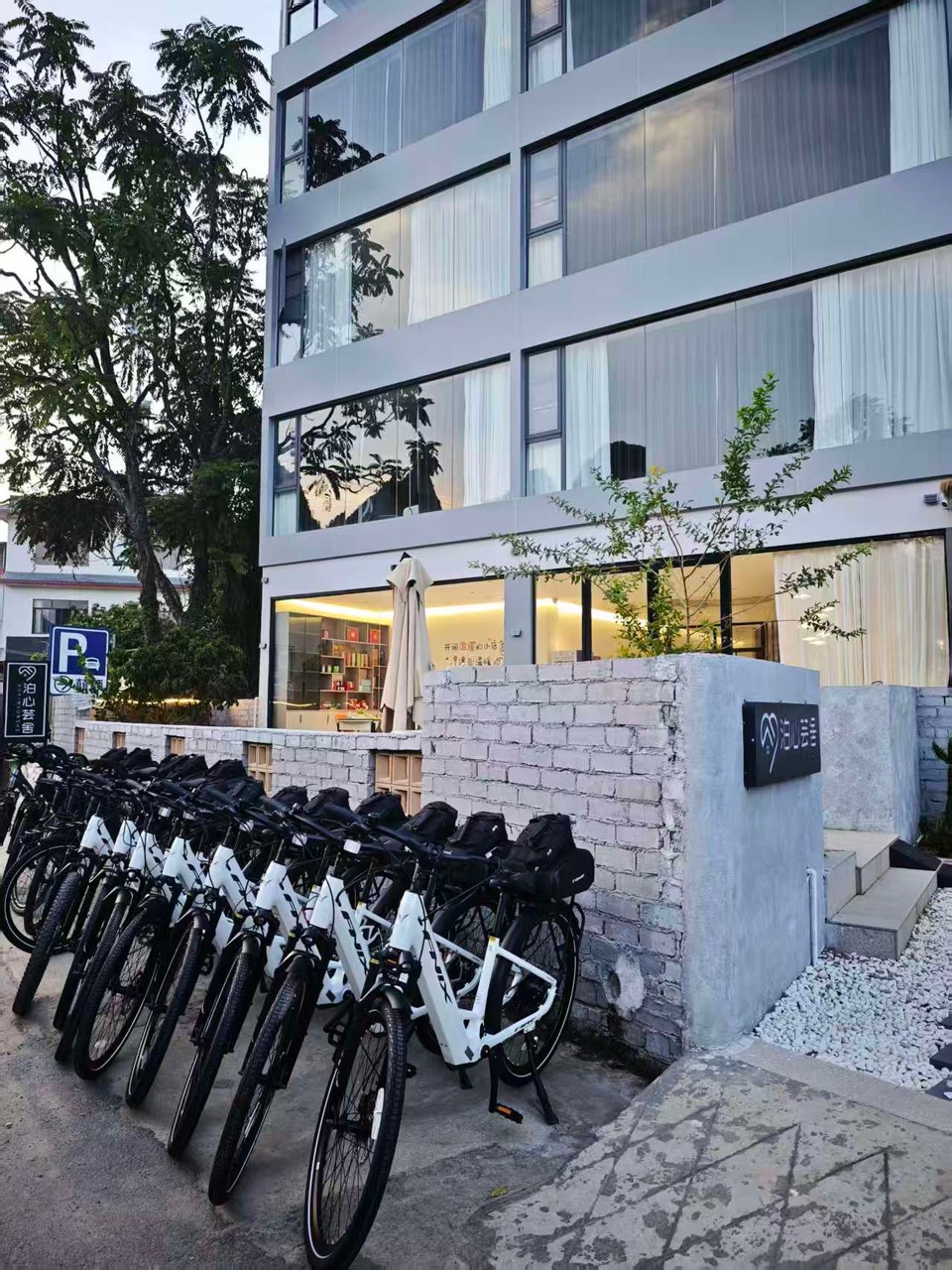
We maintain fleets of over 380 bikes across Dali, Lijiang, Yangshuo, Guilin, Chengdu, Beijing and Wuhan—from Specialized, Giant and Java carbon road bikes to gravel bikes, city touring e-bikes and full-suspension Amflow PL Carbon e-MTBs.
If you do bring your own bike to ride one of our hubs or join a multi-day cycling tour:
- Pedals and helmets: We can fit Shimano SPD-SL, Shimano SPD, Look Keo or flat pedals if you want to travel only with your shoes, or you can bring your own pedals and saddle and our mechanics will fit them at handover.
- Bike box storage & SF Express help: At our physical shops in Dali, Yangshuo, Guilin, Chengdu and Beijing, our mechanics can help you re-box your bike after a loop or coordinate SF Express pickup to your next hotel.
Pre-station and pre-flight checklist for cyclists in China
- Leave all CO2 cartridges at home. Chinese airport and high-speed rail X-ray scanners flag compressed gas cylinders almost 100% of the time. Pack a frame-mounted mini pump or borrow a floor pump at our shops.
- Keep multi-tools out of high-speed rail pockets and airport carry-ons. Put hex keys, chain tools and torque wrenches in checked luggage or ship them inside the bike box; long metal tools and anything with a blade are confiscated at security checkpoints.
- Measure your folding bike if you plan to use high-speed rail. Wrap it completely in a proper carry bag before entering the station so no grease-covered chain or derailleur is exposed.
- Book airport transfers that fit a bike box. Standard Chinese ride-hailing sedans (Didi Express) often have trunks too shallow or narrow for a 135 cm Evoc or Scicon bike bag, especially electric sedans. Book a 6-seat MPV (商务车 / 六座) when travelling with a bike box.
FAQ
Can I take a road bike in a soft rinko bag on the Guilin-to-Yangshuo or Kunming-to-Dali high-speed train?
Do not count on it. Both routes run standard G and D series high-speed trains governed by the 130 cm (length + width + height) carry-on limit, and neither line is part of the 12306 Bike-on-Board pilot. For Guilin to Yangshuo, the best way to move a bike is to ride it down the Li River corridor on our 90 km Caoping route (G6) while we transfer your luggage by van.
Which high-speed trains in China officially allow full-size bicycles onboard?
As of 2026, only eligible trains marked with the “车” icon on the Beijing North–Chongli (Jingzhang) High-Speed Railway and the Hainan Round-Island High-Speed Railway offer the ¥88 12306 Bike-on-Board service.
How much does it cost to ship a bike inside China with SF Express?
Typically ¥120 to ¥260 ($17–36) for domestic land freight in a standard cardboard or hard bike box, depending on distance and volumetric size, arriving in 2 to 4 days.
Can I carry my Garmin, Wahoo and SRAM/Shimano electronic shifting batteries on Chinese trains and flights?
Yes. Bike computers (Garmin, Wahoo, Hammerhead) and small removable derailleur batteries (SRAM AXS) or internal seatpost Di2 batteries are within consumer electronics watt-hour limits. Carry removable lithium batteries and head units in your hand luggage on flights, never loose in checked baggage. High-capacity e-bike traction batteries are prohibited on both trains and planes.
Sources and last verified
- China State Railway Group (12306), Passenger Transport Regulations — Carry-on Luggage Size (130 cm HSR / 160 cm conventional) and Weight Limits (opens external site)
- Beijing News / China Railway, 12306 “Bike-on-Board” (自行车随身行) service rules, ¥88 pricing and pilot stations on Jingzhang HSR and Hainan Round-Island HSR (opens external site)
- SF Express (顺丰速运), Volumetric Weight Calculation and Large Item Packaging Standards (opens external site)
- CycleQuest China, Multi-City Bike Rentals & Rental Terms
Last verified: 17 October 2026